When the weather outside is hot enough to fry an egg on the sidewalk, sometimes all you can do is work on a project for cooler days. I had a canvas leftover which I wasn’t sure what to do with, so I decided to do my own spin on a macabre subject. I’m not an expert painter by any means, but I’d like to share how I did this. Using a grid to transfer or enlarge images is so useful, and can be used beyond painting.
- 1 canvas
- assorted paints, paintbrushes, palette knives, pencils
- acrylic clear topcoat
- plastic or paper sheeting
- Take a picture of your subject, whether it be a screenshot or live on your phone. Go to the edit button and draw a grid pattern over the picture. 3 or 4 lines is enough, you don’t want the grid to be too small. Save your edited picture.
- On your canvas, use a pencil to lightly draw a grid on the canvas that is the same number of lines and squares as your picture. There may be some trial and error, but copy as best as you can. This is going to serve as your guide.
- Working from square to square, lightly sketch out your painting. I needed to make adjustments as I went along, but keep in mind it does not need to be perfect.
- Lay out your background color. I chose Payne’s gray watered down to start the background.

This was my first coat of background colors. Sometimes it helps to just cover your canvas like this and get the white out of the way!
5. Build up your colors from light to dark. You can always cover a light flub but it’s harder to do once you go deeper. I built cool brown from purple and red and started laying down where I wanted shadows.
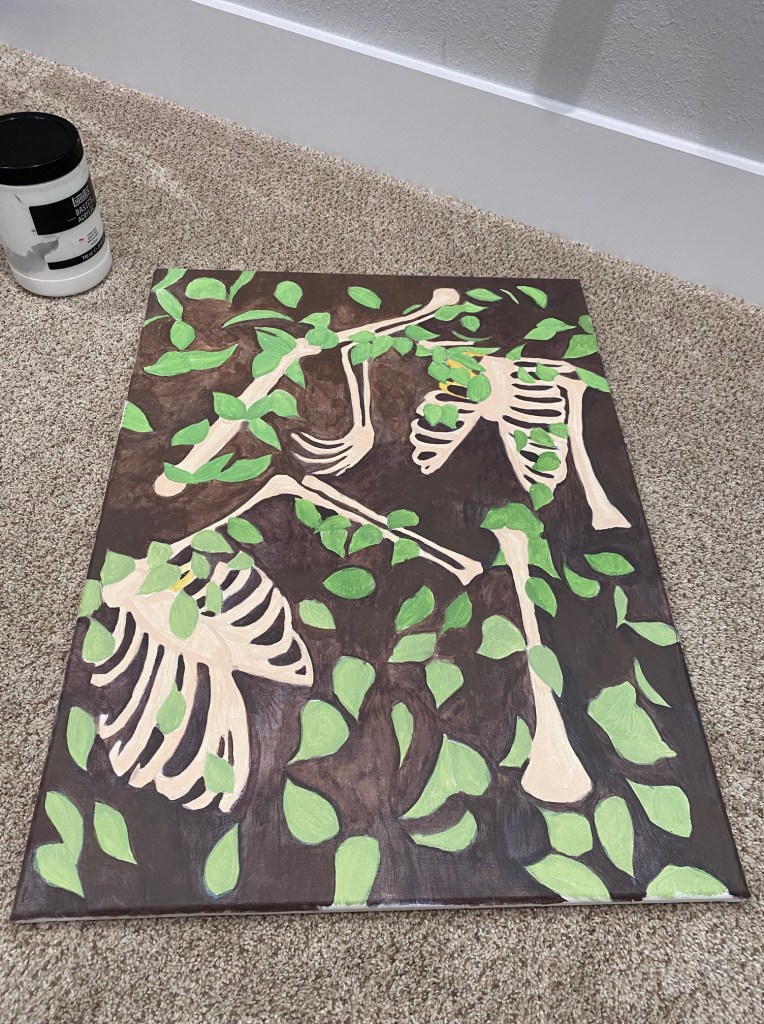
6. Add more detail. In my case, I worked on my leaves, adding different shades of green to add detail and depth. I added shade to the bones, and lightly added some white to highlight certain areas. Using a sponge, I watered down some Payne’s gray to add even more shadow around the edges of the painting.
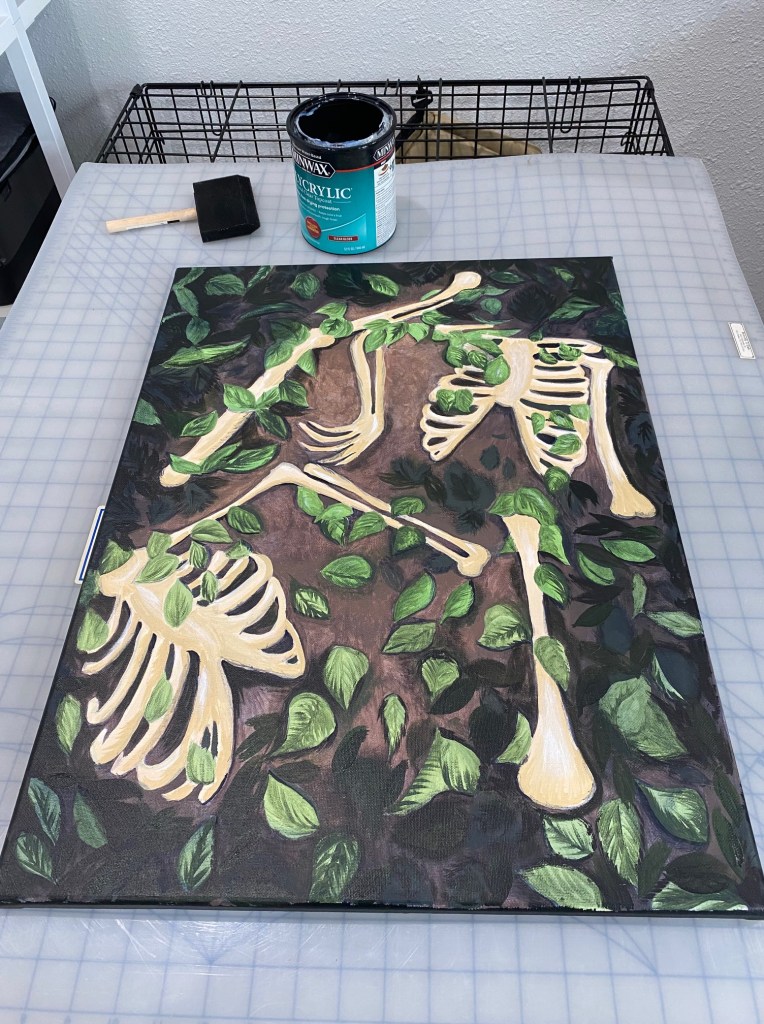
7. To give the painting polish, I added a clear topcoat. I like to use a snake pattern, one side to the other, to cover the canvas as evenly as possible. Using a sponge brush, lightly move the topcoat in long even strokes until you are satisfied the canvas is completely and evenly covered. Allow to dry, and your done!

 The Dupery